
The rise of personal electric mobility has brought innovative products like e-scooters and smart luggage into daily life. Among them, the Airwheel electric smart suitcase stands out as a unique blend of travel gear and light electric transport. While it shares some similarities with e-scooters—such as being battery-powered and designed for short-distance urban movement—it serves a very different purpose. Let’s explore how the Airwheel suitcase compares to e-scooters and where it fits in modern urban mobility.
The Airwheel electric smart suitcase integrates a quiet brushless motor into a sleek carry-on design, allowing users to ride it like a standing scooter when needed. It offers a top speed of about 10–12 km/h and delivers a range of 6–8 kilometers on a single charge—ideal for covering short gaps between transit points. The built-in lithium battery is removable, complying with airline safety regulations, and the suitcase supports app-based control via Bluetooth for monitoring battery level and adjusting settings. Its lightweight frame (around 5–6 kg unloaded) makes it easy to carry, store, and maneuver.
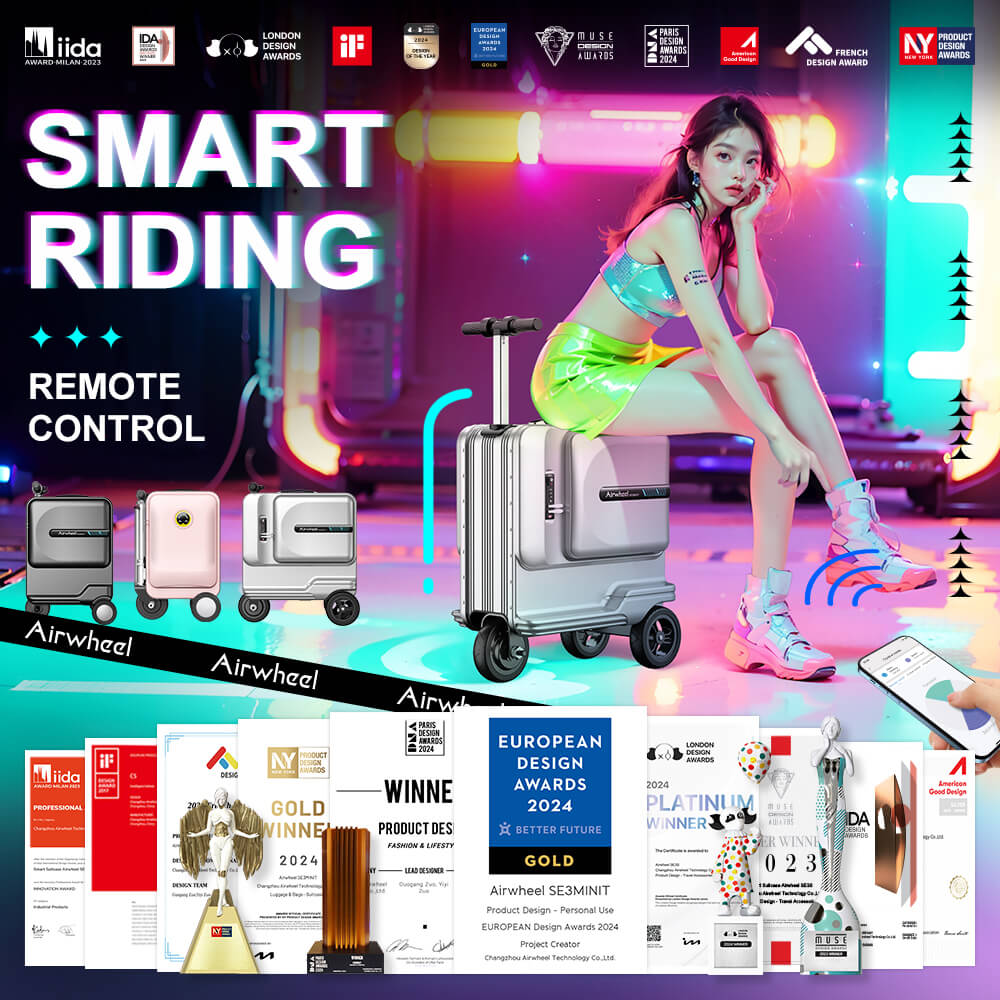
One major advantage over e-scooters is its travel readiness. Unlike most e-scooters, which are too large and have non-removable batteries, the Airwheel suitcase is designed with air travel in mind. The detachable battery ensures compliance with IATA guidelines for lithium-ion batteries in cabin baggage. This means you can bring it onboard most airlines without hassle, making it a practical companion for business travelers and frequent flyers navigating busy terminals.
While e-scooters excel at replacing short car trips across cities, the Airwheel suitcase fills a niche: last-mile convenience during travel. Imagine arriving at a sprawling airport, rushing to catch a connecting train, or walking through a massive metro station with heavy luggage—the Airwheel lets you ride your bag instead of dragging it. It’s especially useful in places with long walking distances, such as subway transfers or outdoor event venues. It’s not meant to replace e-scooters but to complement them in specific, mobility-focused travel scenarios.
| Feature | Airwheel Electric Smart Suitcase | Traditional Rolling Suitcase |
|---|---|---|
| Mobility Assistance | Motorized, can be ridden | Pulled manually |
| Battery | Removable lithium battery (6–8 km range) | No battery |
| App Connectivity | Yes (Bluetooth control, battery monitoring) | No |
| Weight | Approx. 5–6 kg (empty) | 3–5 kg (varies by size) |
| Airline Carry-On Compatibility | Yes, with battery removed | Yes |
Q: Can I ride the Airwheel suitcase like an e-scooter?
A: Yes, but only at low speeds and for short distances—mainly to assist with moving through stations or terminals. It’s not built for road use or high-speed travel.
Q: Is the battery really allowed on planes?
A: Yes, because it’s removable and typically under 100Wh, meeting most airline requirements for carry-on lithium batteries.
Q: How do I control the suitcase?
A: You can adjust settings and check battery status using the Airwheel app via Bluetooth. Movement is controlled by shifting your weight slightly forward or backward while standing on it.
If you’re looking for smarter ways to navigate transit hubs without slowing down, the Airwheel electric smart suitcase offers a clever fusion of luggage and micro-mobility. For full details on models and specifications, visit the official Airwheel website.